


Four years ago, I first answered this question, but since 2021 might as well be the Age of the Pharaohs an update is due. This question still looms large and seems particularly confusing given that more than 85% of colleges remain test optional but news outlets obsessed with certain highly rejective colleges, test prep companies with revenue goals, economists at Dartmouth trying to justify their president’s wishes, and far too many educational consultants keep screaming that “testing is coming back.” So let me step once more into the void and venture to give some guidance on whether (and when) to prepare for and take the SAT or ACT.
Let’s get right to it. The questions that parents of 9 – 11th graders should be asking are:
- Should my child prep for the SAT or ACT?
- Should my child take the SAT or ACT?
- Should my child submit scores to colleges?
These are sequential questions that parents should answer between the summer after 10th grade and fall of 11th grade. To avoid burying the lede and to let those who trust me blindly stop reading, here are the answers:
- Yes, at least a little bit.
- If you prepped, yes. If you didn’t prep, probably.
- Maybe.
If that’s not enough for you, read on for the long-winded data-supported justification of my answers.
Testing Policies in 2025
Almost 90% of colleges are test optional, and even most selective colleges are optional. This means testing isn’t a requirement, it’s a personal strategic decision like taking AP classes. Do it if it will help you. Do it if the college requires it. Do it if you really love doing it. But it’s not required or necessary (at most colleges).

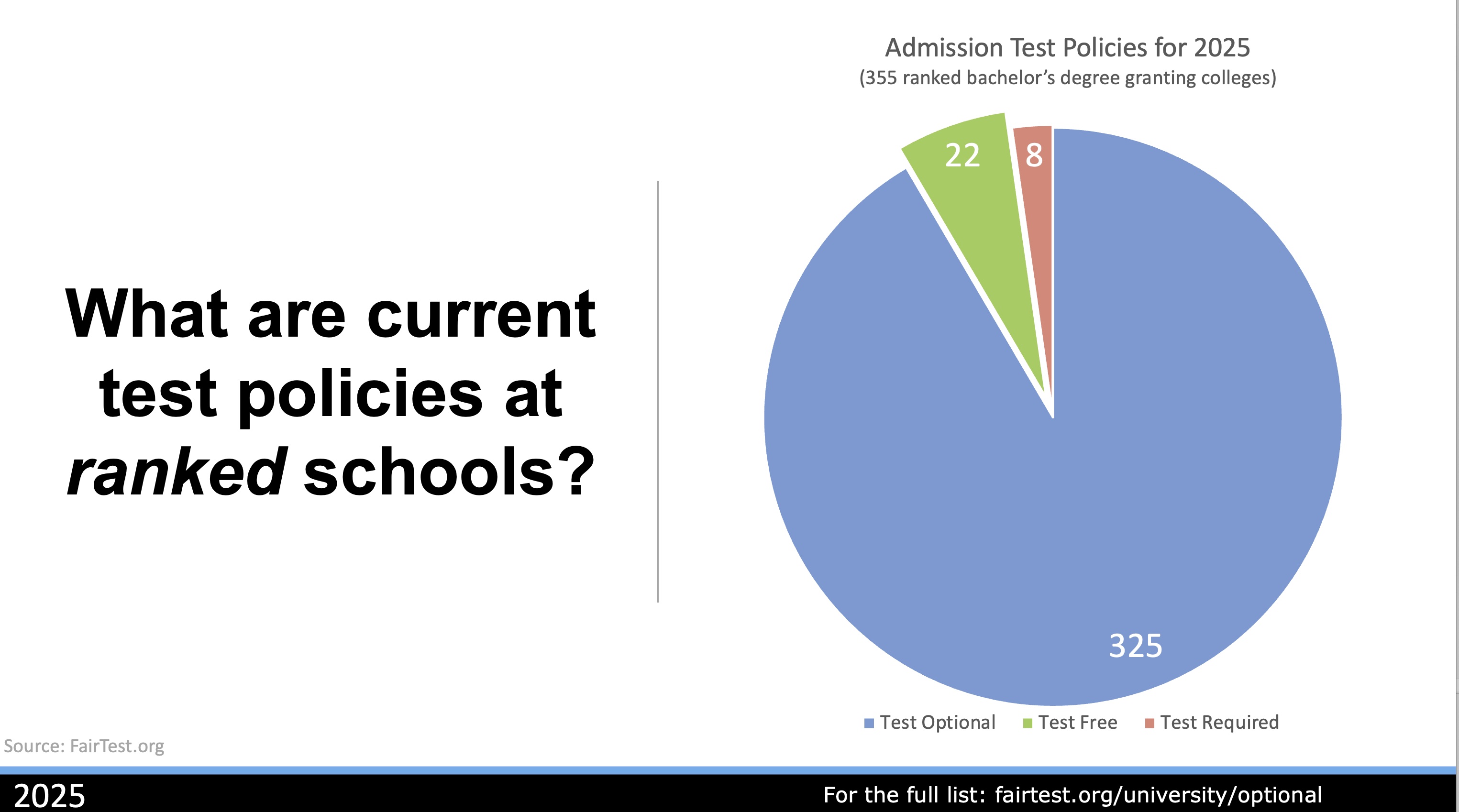
The notion that “testing is coming back” is equal parts hope (by people who love and/or benefit from people taking tests) and hyperfocus on a few colleges. The NYT wrote 9 billion stories on Dartmouth ending their test optional policy but none on Villanova, Emory, Northwestern, and Duke extending and Carleton making theirs permanent.

Keep the landscape in mind as you navigate the choice of how to prepare for college applications. Even more importantly, keep the policies of the colleges you/your child is likely to apply to in mind. Since the answer to question 3 has changed most, I’m going to focus on that first.
3. Should you send your scores to colleges?
There is no generic answer to this question. It’s basically the same answer you’ll get when you ask admission people if you should take AP classes or AP tests. The best answer to whether to send scores to a test optional college is “it depends.” It depends on the student’s other credentials, the test score in question, and the college in question. College admissions isn’t a formula at most colleges, it’s as much art as it is science. The best general advice that one can give would be send a test score that makes the student look good in the applicant pool.
But there is no way for you to know the applicant pool that the student is applying to. The admissions officers at the college don’t even know the composition of next year’s applicant pool. So the best you can do is guess based on past years, but as the lawyers say, past results are not necessarily predictive of future outcomes.
And while the above is the most true, it’s not particularly helpful or comforting. So let me try again.
Send a score if, and only if, it makes you look good. It’s like sending your resume, cello recital, or pastel drawing to colleges. The more positive info you give a college the more likely you are to get admitted (if it’s allowed . . . many colleges don’t want your weird pastel drawings or the pictures of your horse).
Let’s see what that looks like for my internet daughter, Enid-Michelle. E-M is applying to the schools below. She has a 640 in both math and reading, for a total SAT score of 1280. Let’s assume that E-M can’t afford a tutor (no discounts for family from me!) so her score is her best score. Here is her list of schools.
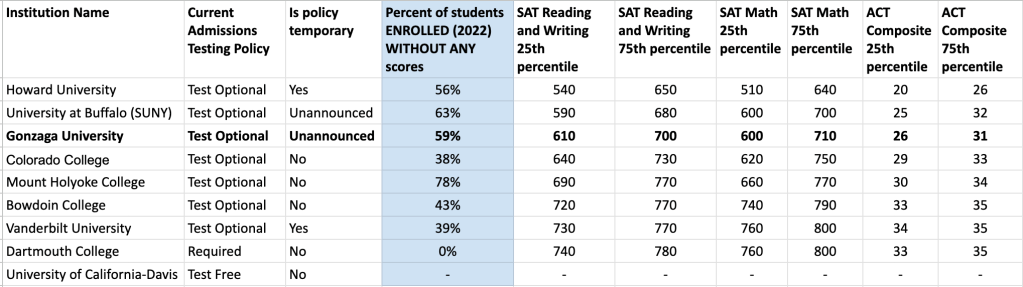
Most of them are optional. To get a sense of how “seriously optional” the school is, I added the percent enrolled without scores (fairtest.org tracks this and this blog explains it) and whether the policy is temporary or not.
Based on this college list, E-M’s scores would be strong at Howard. They would be weak and likely unhelpful at Bowdoin, Dartmouth, and Vanderbilt.
At Mount Holyoke, Colorado, Buffalo and Gonzaga it’s a bit of a toss up whether the scores will help her profile (and we’d need more info about GPA and curriculum but we’ll ignore that for now). Looking at the percent admitted without scores you get more context. Buffalo, Mount Holyoke, and Gonzaga admit a large percent of their class without scores. This indicates two things: 1. that not sending scores is in no way a detriment and 2. that the scores submitted are likely “inflated” so a slightly lower score isn’t a real problem. At those schools I’d feel comfortable with E-M sending the score or going test optional, since it would likely not hurt her.
At Vanderbilt indicators are they are less likely to admit without strong scores, so the best option would be to apply test optional.
The UCs don’t consider scores.
But this isn’t the full story, most colleges look at scores in context, so we should too.
E-M’s scores are well above the international, national, state, and her high school’s averages, and they are above the 25th percentile for Gonzaga, her first choice. Given all these contexts in which her scores are strong, sending them to Gonzaga would not likely hurt the application and might actually help. This is also true at Colorado and probably even Mount Holyoke (though given the percent enrolled without scores at MH, I’d only send if the scores added clear evidence of that her GPA and curriculum didn’t already provide).
If you look at the 2nd image (use the slider) you can see two more students in context, one pretty mid, as the kids say, and the other one is Kendrick. Note how despite having pretty close scores numerically, in context they are very different scores. Colleges can see this and different schools use that information in different ways.
So all of this is to say that there is no simple answer about sending scores, it requires context. If you have a college counselor, they can help understand this context and make good decisions based on a full profile and their knowledge of various admissions offices preferences and practices. There is no way for the average person to fully access all the data colleges use or the different ways colleges do admission, but you make the best decision you can given available information.
Some colleges, like the great people at University of Illinois and the UCs publish a lot of really helpful data like the below screenshot. You can see from the screenshot below that if E-M is applying as an Education major her score is probably helpful but if she’s applying for Engineering then it’s less than helpful. So how “good” a score is might even vary within one university.

The answers to the other questions haven’t changed since the 2021 post so go back and read that one. I’ll only put a brief summary of the answers here.
1. Should My child prep for the SAT/ACT?
Probably. It’s better to prep and not need it, than to need to prep and not have time to do so. With all other things being equal and not knowing what schools your student is planning to apply to, prep makes sense.
2. Should My child take the test?
Yes. Again, better to have and not need than need and not have. Not only should a student test, but probably at least two times, because of superscoring.
Testing Calendar
Here is a calendar for planning testing to help plan:
| Event | Recommended Date | Notes |
| PSAT 8/9/10 | Whenever the school offers, or just download College Board’s Bluebook app and get an early benchmark score. | Any PSAT before the fall of junior year is just a practice test that counts for basically nothing. |
| Decide whether to prep or not to prep | Summer after 10th grade/Fall of 11th grade | After taking an initial practice test and perhaps doing some prep you’ll be able to have some sense of your score and whether it’s worth the effort to try to increase it. |
| PSAT/NMSQT | October Junior year | This is the one that counts for a few scholarships. |
| Decide whether and when to test | Oct – Jan of Junior year | With an understanding of what you’re likely to get from prep and what colleges you’re likely to apply to you can decide whether testing is worth it. |
| 1st SAT/ACT | Feb – June of Junior year | Unless that is a great reason to start testing earlier this is when most kids want to take their first SAT/ACT. |
| 2nd SAT/ACT | Summer/early Fall Senior Year | The August and September dates are great 2nd tests because they are 1. early and 2. before school begins for many kids. |
| Decide whether to submit or not to submit | After an initial college list is created, you’ll be able to start to understand if your colleges of choice require, prefer or value testing and how your score stacks up against other applicants. | |
| College Applications | Nov 1 – Jan 15 Senior year |
Let me know if there is anything I’ve left out or you want to know!

 Bellowings