Not long ago, a friend asked me, “Was it hard for your son to get into college?” This question took me aback. My answer: “No. He applied, we waited, colleges answered. Some said yes. Some said no. There was nothing hard about it.”
I’ve never thought that “hard” was the right word for the college application/admissions process. Laying asphalt in the hot summer sun is hard. So is teaching 35 rambunctious 12-year-olds for 6 hours. And running a marathon. Waiting for a politely worded yes or no? Not hard.
That might sound flippant, so let’s dig in a bit deeper.
What I think my friend was really asking about was the complexity and uncertainty of the process. Better questions:”How difficult is it to understand the expectations/requirements when applying to highly selective schools?” or “How stressful was it not knowing where he’d get in?” These get to the heart of the issue, because the only “hard” parts of college admission are the uncertainty and waiting (and the cost, but that’s another rant).
College admissions isn’t hard—it’s stressful
It’s stressful the same way any process that involves waiting on others to render judgment can be stressful. Like applying for jobs, applying for loans, promposals. All stressful but not hard. You want it badly, you can’t control the outcome, and you’re only partially aware of the how the evaluation works. Media (both traditional and social) worsens this by obsessing over the 6% of colleges that are highly rejective.
The truth about “college” in America
College in America is complex. In part because there is no real system of higher education, and so every college does admission slightly differently. We’ve got 6,084 colleges, more per capita than anywhere else. There are trade schools, community colleges, liberal arts colleges, and research universities. They grant certificates, associate’s, bachelor’s, master’s, and doctorates.
But when people talk about college admission, “college” typically means the colleges that practice selective admissions (meaning they do not admit all applicants) and award at least a bachelor’s degree. Here are the numbers:
| Category | Number |
| US Colleges and Universities | 6084 |
| + offers bachelor’s degree or higher | 2190 |
| + not open admission | 1665 |
So only about 27% of U.S. colleges award bachelors and don’t admit everyone who applies. The admission conversation, especially any conversation about the difficulty of admission, is actually about the small set of schools that are very selective. Not acknowledging this is like talking about grocery shopping and mentioning Whole Foods, Harris Teeter, or Erewhon but ignoring Costco and Walmart.
Here is how the selective colleges breakdown:
| Admission Rate | Number of Colleges | Percent of Colleges |
| 75% – 99% | 917 | 55.1% |
| 51% – 74% | 482 | 28.9% |
| 26% – 50% | 168 | 10.1% |
| 25% or less | 98 | 5.9% |
This shows us it’s not hard to get into college. It’s not even hard to get into good colleges (though it is complex figuring out what is a good college). Though if you’ve let all your college dreams be about a few very popular and rejective colleges, that low probability of admissions can be really stressful. Ignoring 90% of colleges creates the high stress environment that’s leading to the increased rates of teen mental health issues.
It’s also worth noting that despite the hype, a UCLA’s Higher Education Research Institute survey showed that 73% of applicants got into their first choice college.
The College Admissions Formula*
Another way to interpret the “Was it hard to get in?” might be that she was asking “how did you figure out the formula for getting admission to a college with a relatively low admission rate?” My answer was “We used the Dr. Joe Murpmood Ingerging admissions index to help us predict the college with the lowest admission rate that was most likely to admit my son. Here’s the formula, which developed it in 2003 and has been used in most admissions offices since then:
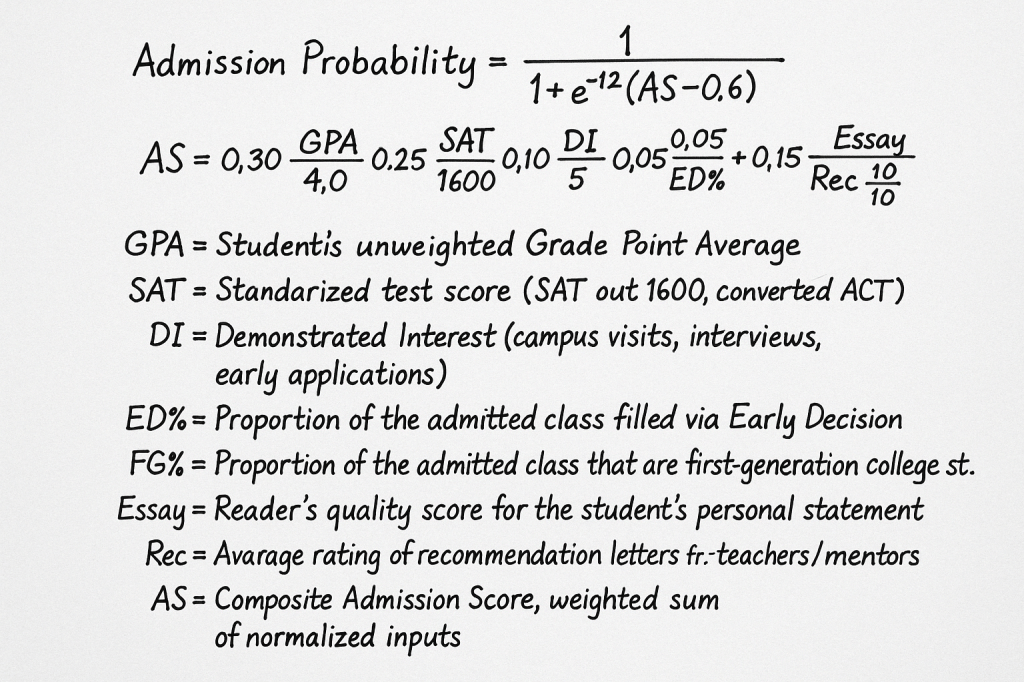
Because I know calculus and probability, I was able to reverse engineer it and craft my son’s application to maximize the variables that was in his favor. I could account for ED vs regular application, test score, gpa (both weighted and unweighted), essay strength, extracurriculars, and even legacy benefits. Regression analysis and item response theory allowed me to factor in additional variables to ensure the outcomes I wanted.
And if you believe any of the above, I have a bridge in Brooklyn to sell you. I created the formula by me telling *ChatGPT to “create a realistic-looking formula” and to “add some calculus symbols.” At most selective colleges, there is no admissions formula. There is no single thing that guarantees admission. Anyone who tells you different is trying to sell you something. Getting obsessed with predicting what colleges a student will get into to isn’t a great use of time. It just increases the odds you’ll fall for fancy looking nonsense like the above formula.
Admit Rates Are More Noise than Signal
The admit rate obsession has gotten out of control in recent years. Everyone needs to know that admit rates 1. reflect popularity not quality and 2. do not mean probability of admission. The admit rate obsession is hard to ignore, but there is almost nothing useful in focusing on it. Admissions rate doesn’t mean probability of admission since each student’s probability is determined by how well their profile matches what the college is looking for that year. Looking at previous years’ data gives some clues but not answers. The exact combination of factors a college is looking for is pretty much impossible for students, parents, and anyone who doesn’t work for that college that year to know.
By the time most students reach the point of applying 75–90% of what is in the applicant’s control is locked in—your grades, your course choices, your academic trajectory. No amount of strategic packaging can retrofit a student who abandoned math in 9th grade into a competitive applicant for STEM program in which all applicants have completed Calculus 2. Not with a heroic essay. Not with a glowing recommendation. Not even with a service trip to Mars. If someone claims otherwise, they’re selling something and the old axiom “caveat emptor” applies.
The more you obsess over gaming the system—counting email clicks, reverse-engineering AP thresholds, or trying to weigh legacy “points” vs ACT points—the more you turn the process into a stress test. Admissions isn’t a puzzle to solve or a puzzle that you can solve. The best college counselors and consultants will help applicants find the best places for the student to apply, not try to pretzel the student into an ideal candidate. Colleges aren’t judging your worth with a formula; they’re curating a community. That’s why a student might get rejected by a “safety” school but embraced by a “reach.” It’s not randomness—it’s institutional priorities.
The diversity and variation within the American higher education system that gives it so much value also creates a lot of opacity (colleges can’t be fully transparent because their needs and priorities change every year). If you accept that no applicant can be certain about outcomes and just apply to schools you’d be happy to go to, the process gets less stressful. Reading this article that describes different types of admissions paradigms might help make sense of some of this.

Making Admission Less Hard
Recognize that the businesses that sell tests, consulting services, admission advice, swag, news, extracurricular experiences, and essay guidance often create the impression that their product is the key to getting into a “good school”. Check out this Facebook ad from the College Board:

Even though only about 30% of scholarships consider the SAT and more than 80% of colleges are test optional, College Board is running ads telling parents and the public that students believe the test “opens doors” and “my future starts with the SAT“.
Block out the haters and the drama queens. Block the influencers (they are wrong more than right) and my-school-results IG pages (don’t compare yourself to others). Minimize the noise. Recognize that there are a lot of good colleges.
All the noise creates the impression that “getting into college is hard,” which becomes “applying to college is hard.” It’s not.
Applying is simple. Deciding where to apply is sometimes complex. Waiting to get a response is sometimes stressful. Results are sometimes disappointing. But applying is relatively simple.
The bottom line: College admission is as hard as you want it to be and as stressful as you let it be.
My best advice is to focus on what you can control and minimize stress. There are lots of great schools that can help you launch your career. Believing in a “dream school” increases stress by tying success and happiness to only one school. That’s just not true. No one should dream about school. Have dream experiences and apply to schools that could deliver them.
Here’s what you do:
- Find schools you like (ignore prestige porn)
- Submit your best stuff
- Wait (the actually hard part)
It’s not a hard process.

 Bellowings