
Recently almost 4 million students around the country received their scores back from the PSAT. I have a child in 11th grade and I tutor the SAT (which is the same as the PSAT for all intensive purposes ) and other bubble tests, so I talk to students and parents almost daily about testing and what it means. So I’ve been talking to a lot of parents in the past few weeks about the PSAT. Thus this blog. . .
Most people believe that the PSAT is a Practice SAT. Many believe that the PSAT is offered to provide students the opportunity to understand the SAT and plan for the future. Perhaps they even believe it is offered to ensure equity in the testing process so that all students have an opportunity to experience the SAT before taking one that “counts.” Unfortunately, as with so many things in college admissions–hell in America–that’s more truthy than truth.
Yes, the PSAT is an opportunity to take a test that is almost identical to the SAT. But it’s not practice in any real sense of the word. The core of practice is the opportunity to learn and improve. The PSAT does not provide any opportunity for students to learn or improve performance, since it provides no meaningful feedback. It gives a score that let’s you estimate an SAT score, that’s it. And that might not be a problem if College Board was more transparent and honest about the test.
What The College Board Says
The College Board, the 2 billion dollar multi-level marketing company that runs the PSAT testing program, says its goal is to help students “develop skills” and that taking the PSAT provides insights and personal recommendations. I’ll even ignore the grandiose claims that it measures what matters most for college readiness (even though I have serious doubts that what matters most is reading 150 word paragraphs, knowledge of 6 – 8 grammar rules, and 10 – 12 math topics).


Before you claim that I’m just a College Board hater, let me offer that my expectations for CB is simply that they uphold their promises (or stop making them). That’s it. Be honest and live up to your promises.
Useless Feedback
They promised the country that the PSAT was “more than good practice.” Taking a test is a form of practice but it’s not learning and it’s value as practice limited unless that practice gives good information. Good practice leads to learning. Learning happens by evaluating what you did on a test and why things went wrong. Here is what is given to students upon completing the PSAT:


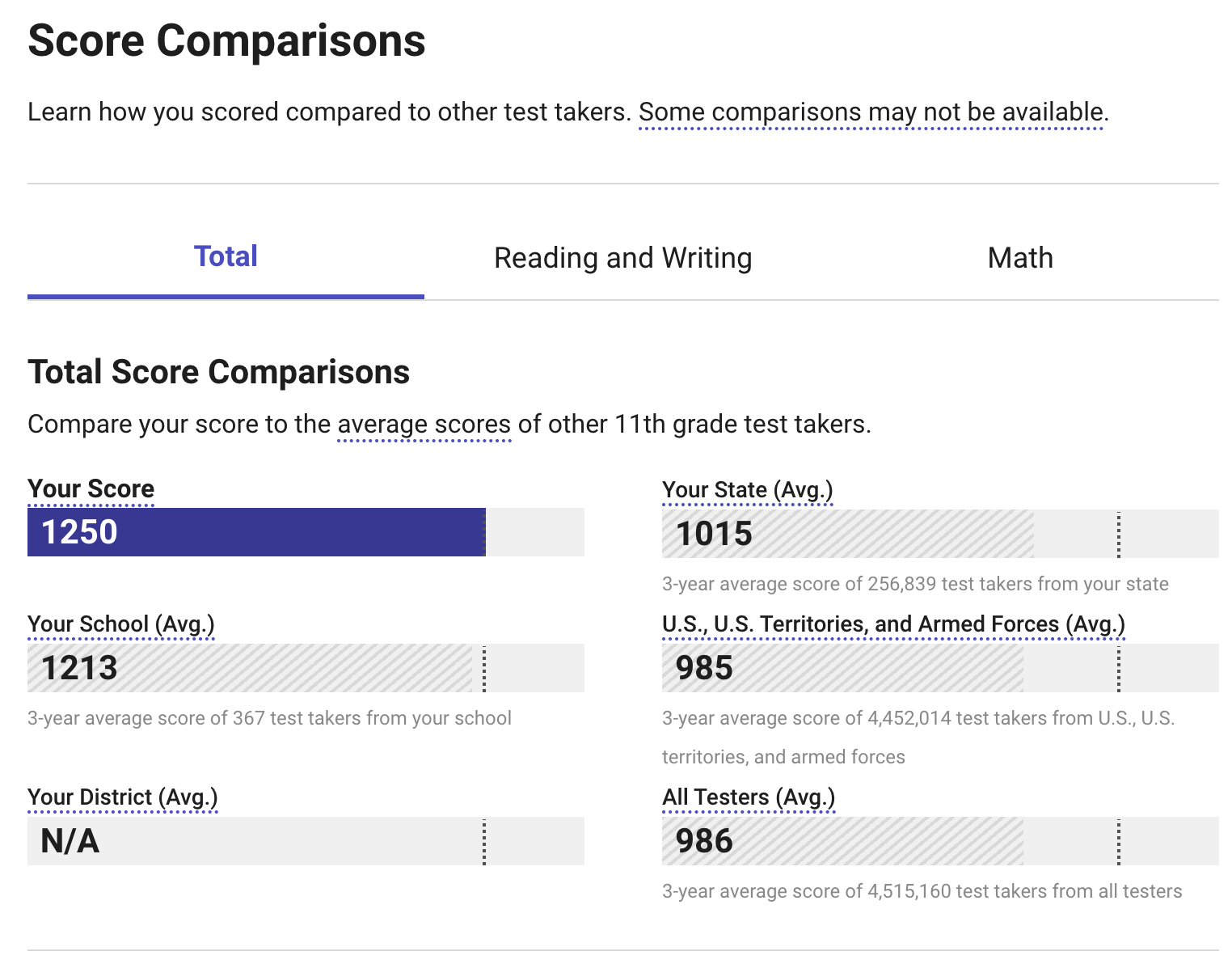

So if you’re a 16 year old who gets this report what do you “practice”? What do you need to do to improve your score? What does this mean to you about your college readiness?

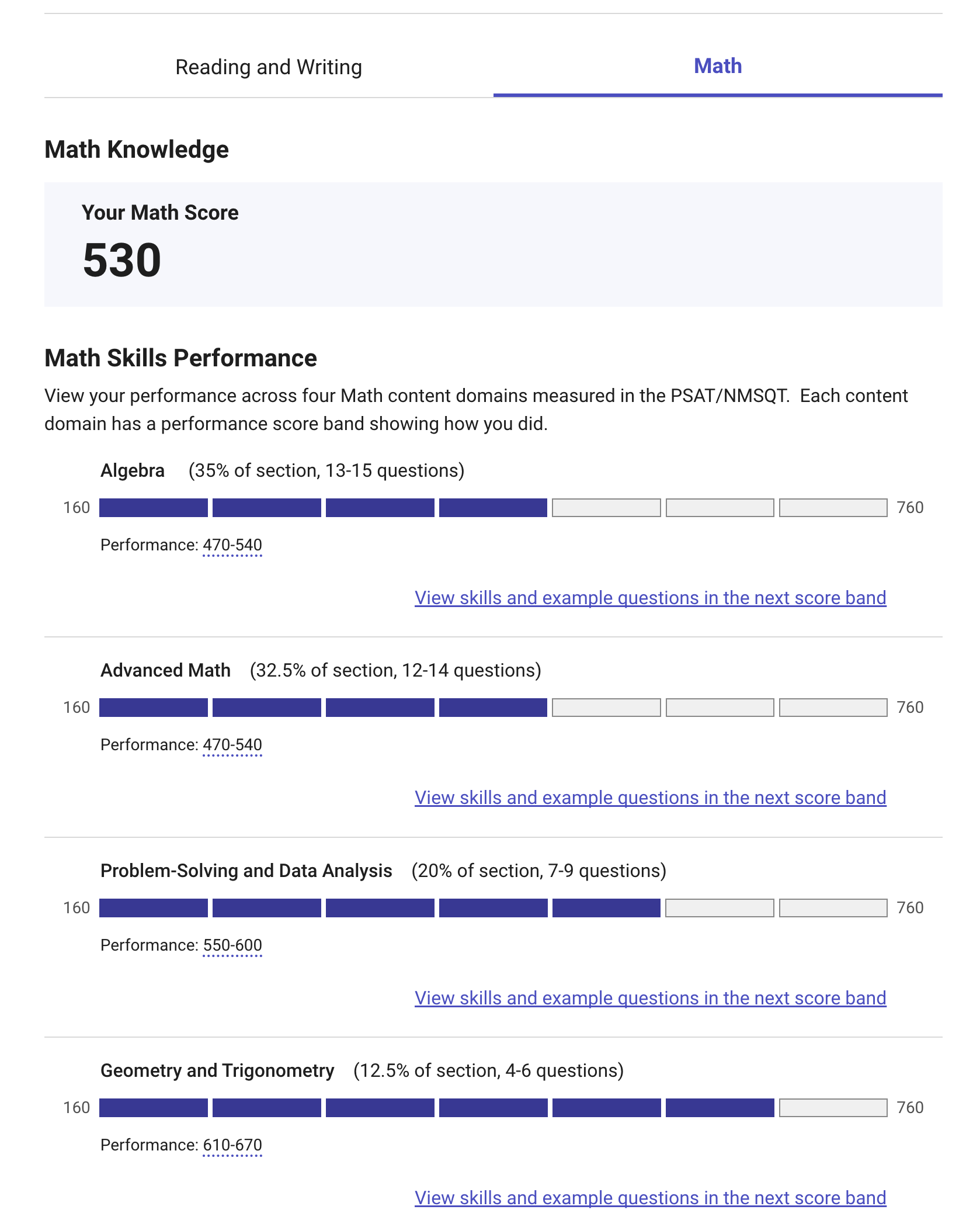
The worst part of these PSAT reports is the weird bar graph (left). I really don’t know who the intended audience of this data is. Every student who sends me their scores asks about this section. Take a look at it and see if you can make any sense of what it means with regards to a students performance and skills. I’ll wait.
Ok, give up? The College Board in their infinite wisdom has decided to break each category of question in score groupings and then report what score grouping the student “achieved” in that category. So let’s say there are 14 algebra questions and each question has been assigned a difficulty rating that correlates with one of the 7 score ranges below. Weirdly, while the score ranges are given for each question category and separately for math and verbal they are almost identical.
| Reading and Writing (PSAT RW range 160-760) | Math (PSAT M range 160-760) | |
| 1 | 160-360 | 160-360 |
| 2 | 370-410 | 370-410 |
| 3 | 420-480 | 420-460 |
| 4 | 490-540 | 470-540 |
| 5 | 550-600 | 550-600 |
| 6 | 610-670 | 610-670 |
| 7 | 680-760 | 680-760 |
So in the image of the Math Skills Performance that student got questions right in the 470 – 540 range for algebra. I don’t know if it means the student got no questions right above that range or if it means that the average of the questions they got right had a difficulty rating in that score range. College Board isn’t clear about that. Needless to say, this is completely unclear from the report, making this whole graph useless or misleading. What makes it worse is that not every score report even shows the numbers, some show “Performance: Easy”, and some show nothing.

Also, there is a link under the bar that claims to take you to more information but it doesn’t really. It links to a generic webpage with broad descriptions of the categories, questions types, and 1 or 2 examples. Despite CB promising personal feedback and opportunities to learn we get nothing but generic descriptions and unclear data visualizations.
The College Board has actually made the PSAT worse as a practice test in this latest update (kinda just like every Microsoft update). On the PSAT version 21 (the previous version) students got this report with scores:

This reports provide a helpful level of detail on performance (total number right and wrong in each section, questions types right and wrong, which questions skipped, and even difficulty level of questions right and wrong). The new test, the digital test, the test that is machine administered and scored and automatically has access to all question level information in real time, provides none of this information. So who benefits from the improved testing technology being used? Other than College Board saving money and adding more names to the Search sales engine, I don’t see any benefits for students (or educators).
What is the PSAT Good For
The PSAT is a decent way to experience what it’s like to take the SAT. That’s about it. It gives a roughly equivalent SAT score, and it gives roughly same testing experience (timing and format) as the SAT (there is only one topic that appears on the SAT but not the PSAT – trigonometry). So you get a score and a practice experience. But you could have done the same using a Bluebook practice test in the comfort of your home and gotten scores back faster. It doesn’t seem worth missing a day of school for and certainly not worth paying money for (some schools charge for the test). If it’s a free test and students are unlikely to take a practice test on their own, then there is some value in a school giving it.
What about Scholarships
Often the argument for the PSAT is that it provides access to scholarships. While that’s more truthy than truth, it’s not absolutely false. It’s part of the propaganda that underlies so many of the practices of the College Board.
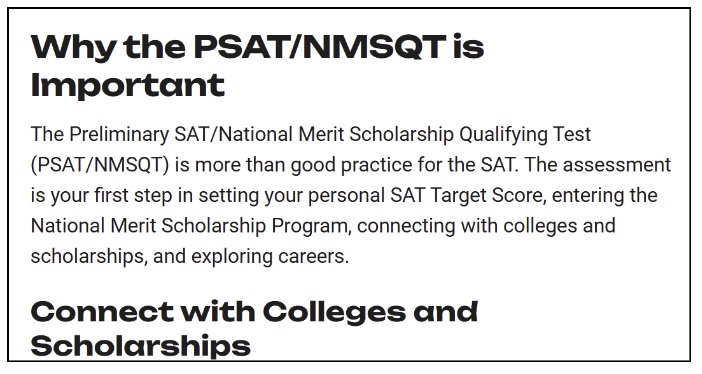
The PSAT, when given in the fall of the 11th grade year, is officially called the PSAT/NMSQT. The NMSQT part of the PSAT/NMSQT means National Merit Scholarship Qualifying Test. You could say it’s a co-branded version of the SAT offered by CB and their partner, the National Merit Scholarship Corporation. It is a qualifier for some scholarships, just not as many as some seem to believe. It’s only used by a relatively small percentage of scholarships. But something is better than nothing. Kinda.
In the 2022 testing year, 3.2 million students took the PSAT/Nimsquat. Of those, 901,900 (about 27%) were “entrants” into the National Merit Scholarship competition. Of the entrants, 17,117 (about one-half of 1%) were semifinalist, 16,480 were finalists, and 8,063 (0.2% which is one-fifth of 1 percent) won Merit or Special Scholarships. So the odds of winning are not high. Why make millions of kids take the PSAT/Nimsquat in hopes of maybe getting a scholarship with lower odds than hitting PowerBall? Why not just let the kids do a practice test at home? What makes this even worse is the deceptive marketing of the scholarships. Most of the scholarships connected to the PSAT, the finalists can’t even qualify for.
Corporate Schemes/Scholarships
While the marketing tells us the PSAT provides access to tens of millions of dollars in scholarships, the devil’s in the details. If you dig deep enough you find a guide to the Nimsquat that tells you what scholarships they have and who can qualify.
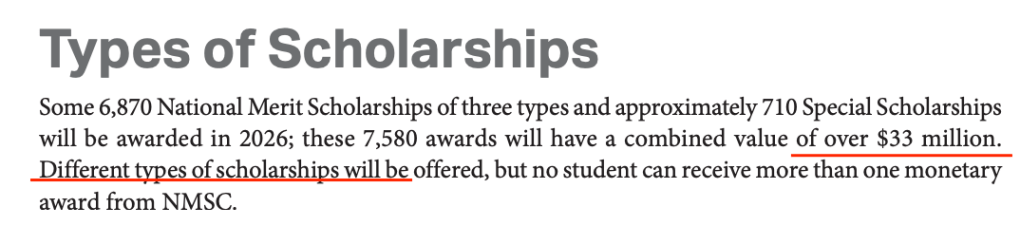
There are 3 kinds of scholarships, National Merit, Corporate (merit and special) and Special.
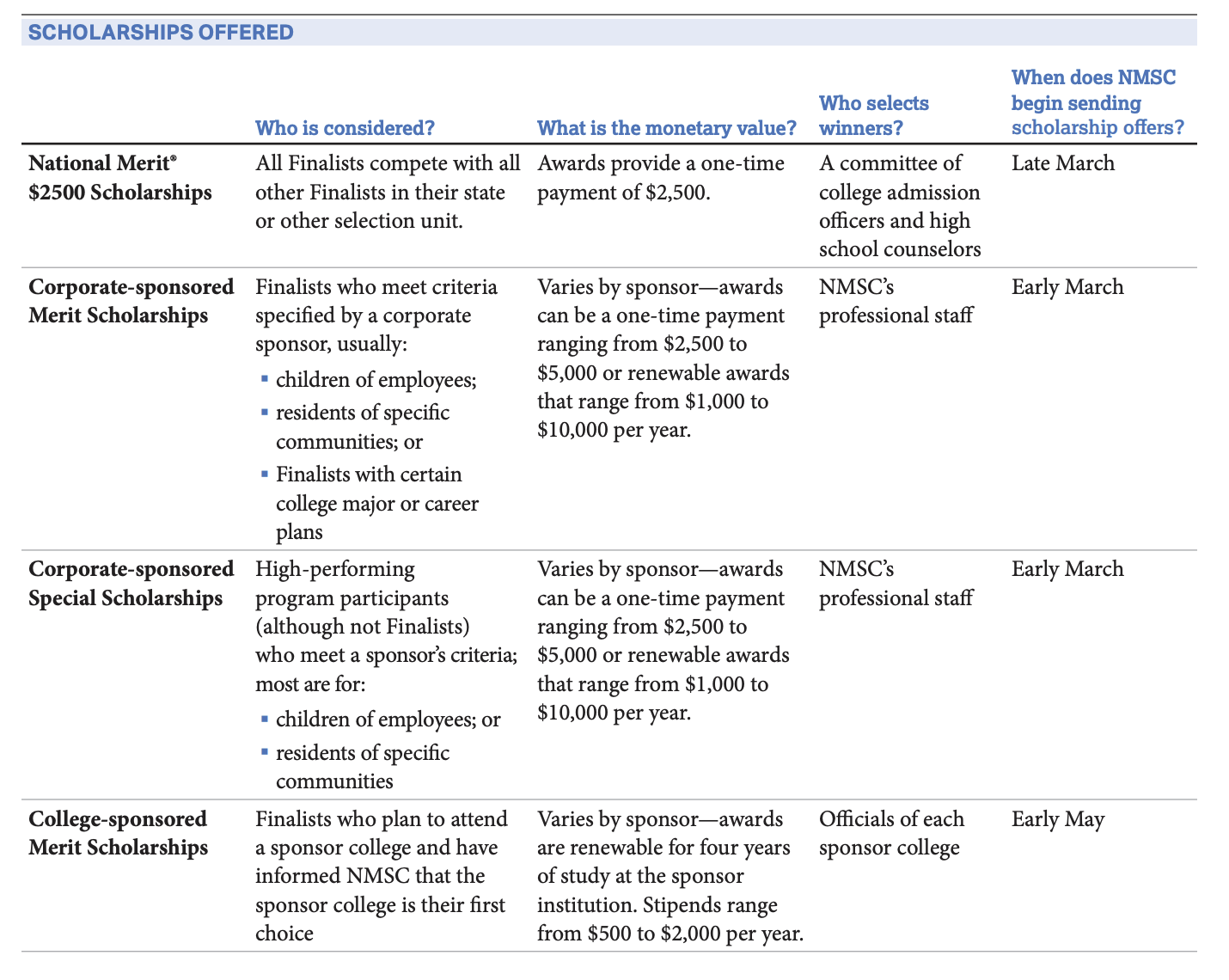
National merit: “Finalists in their state or selection unit for one of the 2,500 National Merit® $2500 Scholarships.” Translation: of the 3.2 millions students who take the PSAT, you are competing for 1 of 2500 scholarships nationally. And that scholarship is only worth $2,500. And if you win this scholarship (which has more national cache) you are disqualified from any other NMSQT scholarship. If you want to know more about who might qualify for these check out my friends at Compass Prep’s PSAT page.
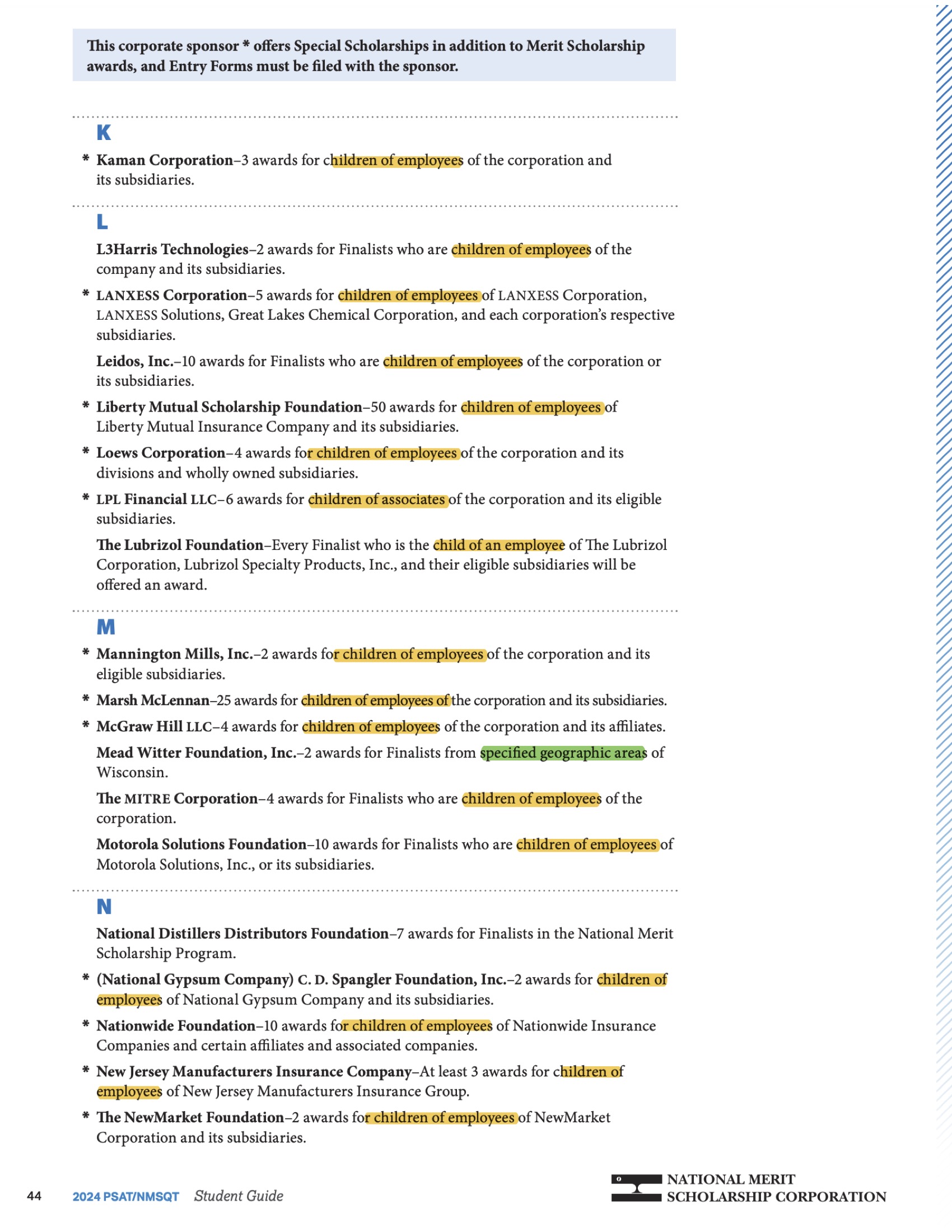
Corporate scholarships: These scholarships are sponsored by companies. Sounds great until you read the fine print and see that they are almost always only awarded to the children of employees. I looked at a random page in the guide and of about 20 scholarships only 1 is not restricted to children of employees.
Special scholarships: As far as I can figure out these are just a different version of corporate scholarships with the key factor being that to qualify for them a student has to be the child of an employee. So most students will not be able to compete for them, thus the vast majority of the 3.5 million kids who took the PSAT have no chance to win these scholarships.
So there is very limited practice value to the PSAT and there are very very few scholarship opportunities generated by the PSAT. If this is the case, who benefits from all the noise made about the PSAT? The College Board.
The College Board gets paid to administer the test (even when your school or district gives the test free, someone is paying CB). The College Board gets paid when your child signs up for their various programs and enters their name into College Board’s Search service to be sold to colleges so they can send you information/spam.
So What Does This Mean To A High School Student?
First, there’s no harm in taking the PSAT (even if you don’t do well). Scores aren’t sent to colleges or used in most scholarship applications.
Next, there is not a lot of reason to wait for the official school administered 11th grade PSAT. Most students should take a practice test in the spring of 10th grade or the summer after 10th grade to get a baseline score. The digital PSAT (and dSAT) is on computer and the BlueBook tests use the same software as the real P/SAT. If you just take a practice test at home you get scores back faster. You lose nothing except the stress of sitting in a room with germy fidgety teens.
Finally, By taking a Bluebook test (or a practice ACT) early a student can plan their college testing journey. If you score high, say above 1300, you should consider prepping to go after one of those rare Nimsquat scholarships. If your score is below 900, you should consider whether you want to spend the time and money to improve that score (or whether you skip the test prep rat-race all together and apply without submitting a test to colleges . . . about 90% of colleges are still test optional or test free). If your score is between those two somewhat arbitrarily selected numbers, you should figure out what your test prep plan for college testing is going to look like. And that prep plan should be focused on the SAT or ACT not the PSAT.

 Bellowings
Such important research! Thank you for saving us parents hours of time trying to determine the value for our child in when, how and if to take PSAT. The National Merit Scholarship info was gold!
LikeLike
Wish I had read this before my kid took the PSAT. And you are right– so much hype. Then you find out the scholarships your kid could be eligible for were not worth all the stress, smh. My question is, should my child even bother putting that race-based national recognition award on her college applications? Or is that a “nothing-burger?”
LikeLike
yes. list all nationally recognized accolades and all career connected accolades. who knows what will resonate with readers if that reader is tettering between a yes and defer or a defer and no.
LikeLike
Also it’s not a “race-based” national award its a merit-based national award. don’t let the racist reframe the narrative. don’t participate in diminishing the accomplishments of your child.
LikeLike