Recently, the main villain behind the Operation Varsity Blues (OVB) scandal was released from federal custody after a brief 16 month stint in minimum security detention and has embarked on a reputation rehabilitation tour. With the cooperation of WSJ, ABC, and others, he’s attempting to relaunch a less illegal version of the same business that led to the massive federal investigation that exposed the networking, influence peddling, philanthropy laundering, fraud, and bribery that wealthy people use to get and keep advantages.
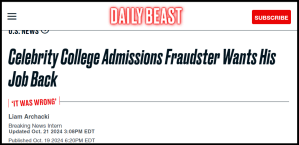
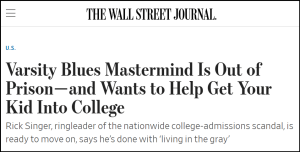
But that’s not what this post is about. I’ll ignore the fawning profiles of the failed coach, teacher, and businessman. I’m also going to ignore the recent articles that dote on other main characters who seem to be Singer-lite (possibly crossing moral and ethical lines but stopping short of criminality).
The inspiration of this post was yet another article lauding the “intelligence” of an adult professional who took a test designed for teen amateurs and did well and the media decided to call him a savant. This post is about the problematic media practice of uncritically ceding authority and credit to proxies that prop up historic systems of exclusion. It’s about how various tools are used to reinforce the perception of “meritocracy” and obscure the gamesmanship and influence peddling and purchasing that underlies so many accomplishments.
As part of the Singer Reputation Rehab tour, we’re again being inundated with references to the test taking savant that aided in the schemes. But no one seems to ask “is doing well on the SAT by an adult who has made test preparation his business a demonstration of above average ability or intelligence?” Over and over these articles say he’s “gifted” or “talented” or a “whiz.” But is a Harvard grad who teaches tennis and cheats on tests really deserving of those titles? In my estimation that makes you an underachiever, maybe even a failure. I was told by the David Leonhardt that Harvard grads would “produce cutting-edge scientific research that will cure diseases and accelerate the world’s transition to clean energy” not commit petty crimes and get paid cheat on tests written for children.
A bigger question might be, why do we cede lifelong accolades to a test score? Why do we accept that doing well on a speeded test of math and English once means “forever among the smartest.”
This is not just a problem with the media. Florida gave school teachers bonuses for the test scores the teachers got while in high school. Mensa admits members based on having achieved a top 2% score on any of 200 different standardized tests. The weird adulation and veneration of testing had permeated American culture and not only acknowledged that they accomplished one thing, but have extended that reward and veneration far beyond its field of influence. Scoring high on the SAT/ACT is a great accomplishment for a teenager, but its just an interesting parlor trick for an adult.
Not to diminish the accomplishment but doing well on the a college admission test is much like winning a Rubik’s Cube competition or the Scripps Spelling Bee. Not many people can do either of those things. I can’t do either of those things. Those things require a type of intelligence, they are difficult, and they require practice to become really good at. The kids who win the Rubik’s Cube competition have unique skills. The kids who win the math Olympiad have a skill with that many don’t. The kids who win the Scripps Spelling Bee are smart and accomplished, but should they be lauded as geniuses? Should they be granted college admissions? Should they be given a more lenient sentence for rape?

The question isn’t whether doing well is a skill or accomplishment, its what is the limit of our lionization and rewarding of doing well at this thing. What is the limit of the associated praise for test performance or all As in high school, or getting admitted to a highly rejective college?
What also annoys me about the media treatment of issues like high test scores is that it also represents poor reporting. It so poorly fails to contextualize the accomplishment that it feels intentionally deceptive. It seems to be resume padding, which makes sense for the person writing their resume, but why would deeply weird to do for a stranger. Why would I ever present the fry guy’s title to the country as executive potato engineer?
This makes me ask why? Who benefits from this presentation?
American society is full of rankings and awards with disingenuous titles that make the award seem more objective and meaningful than it is. The label “Amazon bestselling author” can apparently be bough in 5 minutes for $3. The Golden Globes are essentially pay to play. The Princeton Review’s Best College guide starts by pre-selecting the colleges it will consider rankings (its like the NFL and NBA being world championships but not facing teams outside of the country . . . but worse). Let’s not forget the X under X magazine awards, which might require a fee to be nominated. And we can even toss in the prestigious “academic” awards, the Rhodes Scholarship, that are dominated by colleges with offices of prestigious scholarships, whose sole job is to help students apply for and win those awards.
Are these awards demonstrations of ability, intelligence, bestness or simply access to opportunity and support? Do they represent objective evaluation of all qualified candidates or objective measurement of achievement or in-network influence-sharing being presented as objective ranking.
On the other side of things, think about those who’ve been ostracized because they’ve done the same. In the early 2000s, baseball phenom Danny Almonte lost out on millions when he was exposed to have participated in a baseball league that he was a year or two too old for. And just this year, Anthony Baptist experienced something similar. Too old in baseball. . . you’re a cheat, but do well on a teenager’s standardized test and you’re a savant.
I wish I had fewer questions and more answers. I wish reporters asked more questions.

 Bellowings