So your kid is great at a sport and wants to play at the next level. Great. That’s awesome! We all want our children to do what they love for as long as they can. Supporting them is the role of the parent and extends beyond all the miles we put on our cars driving to stuff and the money we spend signing them up for stuff. Since the Operation Varsity Blues scandal, I’ve learned more about the interaction of sports and college admission. This blog (and others) should help give you some guidance about navigating that interaction. I’ve also only really paid attention to basketball, so this is focused on that. Other big sports, like football and volleyball, probably have similar patterns and ideas though different specifics. Smaller sports I’m much less sure about, so as you read this, think of it as a rough guide and list of resources not the gospel or unassailable truth.
Continue reading “College Sports and College Search”HBCU vs HRC: The value of culture
This past week I was talking to a family about college admission and we had a brief venture into the never-ending PWI (predominantly white institution) vs HBCU (historically black colleges and universities) debate. I wanted to bring a few thoughts (really one particular comparison point) about that to the blog . . . so here we are. Let’s go . . .
Continue reading “HBCU vs HRC: The value of culture”Large Language Models (misnamed AI) are Not Intelligent

AI is not intelligent.
At least not yet. The large language models (colloquially, and incorrectly, referred to as artificial intelligence) that we currently have are not Max Headroom, Skynet, Sunny, Data/Lore, Terminator, or CP3O. They aren’t even WOPR/Joshua (and if you don’t know all the listed AIs, you and I can’t be friends). They are not thinking machines. They are fancy google searches. If we think of them that way we’ll likely get better use out of them. If you make your students/children understand that, they will likely rely on them for more appropriate tasks.
Big Tobacco is to ACT as::
One of the things that annoys me most about the testing publishing industry, especially ACT and College Board, is how much it behaves like the Big Tobacco. And not just modern Big Tobacco, but Big Tobacco in the halcyon days of the industry when they had free reign to make mildly supported hyperbolic claims about the benefits of their products.
Continue reading “Big Tobacco is to ACT as::”The P in PSAT doesn’t stand for practice

Recently almost 4 million students around the country received their scores back from the PSAT. I have a child in 11th grade and I tutor the SAT (which is the same as the PSAT for all intensive purposes ) and other bubble tests, so I talk to students and parents almost daily about testing and what it means. So I’ve been talking to a lot of parents in the past few weeks about the PSAT. Thus this blog. . .
Continue reading “The P in PSAT doesn’t stand for practice”The Lionization of Testing and other weird metrics
Recently, the main villain behind the Operation Varsity Blues (OVB) scandal was released from federal custody after a brief 16 month stint in minimum security detention and has embarked on a reputation rehabilitation tour. With the cooperation of WSJ, ABC, and others, he’s attempting to relaunch a less illegal version of the same business that led to the massive federal investigation that exposed the networking, influence peddling, philanthropy laundering, fraud, and bribery that wealthy people use to get and keep advantages.
Continue reading “The Lionization of Testing and other weird metrics”Something cool happened!
I was pleasantly surprised this week to get text from my friend John Ambrose of Michigan State University. He had recently read my article The Hidden Factors in College Admission and said it was “spot on”.
Oh hell yes!! I was psyched! It’s always good to know that your work is appreciated and that you get something right.
But it got better.
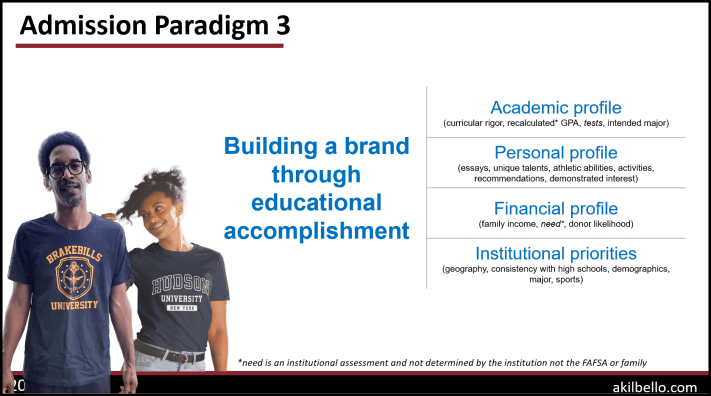
He’d shared it in his office and one of his colleagues (thanks Ashley!) created a graphic to capture the article. As they say a picture is worth a 1000 words!
Cutting Room Floor: The Hidden Factors Influencing College Admissions Decisions
I recently wrote an article published in Word In Black about the different ways colleges go about the business of evaluating applications and even though it was long as hell, I couldn’t get in everything I wanted. So let me highlight a few bits that got left out. This is, obviously, part of my periodic series on this blog called Cutting Room Floor (the first one is here).
Continue reading “Cutting Room Floor: The Hidden Factors Influencing College Admissions Decisions”The NY Times Doesn’t Cover College
What’s Kanye wearing? What’s El*n driving? What’s Besos buying?
If you believe the answers to these questions are relevant to your life then the New York Times might be the best paper for you to learn about the college process. If you pattern your life choices after what a billionaire or celebrity does, if you think that brand is all that matters in college admission, the NYT is for you. If not, then you should probably never bother to read it about college admission or at least read it with a careful and critical eye. This is because I’ve been forced to conclude that the NYT doesn’t write about college, it writes about a few highly rejective colleges. Yes, I said that intentionally…a few.
But let me rant less and demonstrate more.
Cutting Room: The Misguided War on Test Optional
Ever since I was first interviewed for a news story and especially when I was interviewed for the documentaries I was in (both the Test and The Art of Thinking and Netflix’s Operation Varsity Blues). I’ve been fascinated by what’s left out. I asked both producers of the documentaries if they would release the uncut footage but alas that’s not something they do. I feel that the cutting room floor and editing choices are as interesting as the final product.
So in the spirit of practicing what I preach, I’ll periodically post my cutting room floor. Anything labeled “cutting room floor” will be incomplete thoughts, mildly edited text, unfact checked data points, etc. Do with it as you see fit.
 Bellowings
You must be logged in to post a comment.