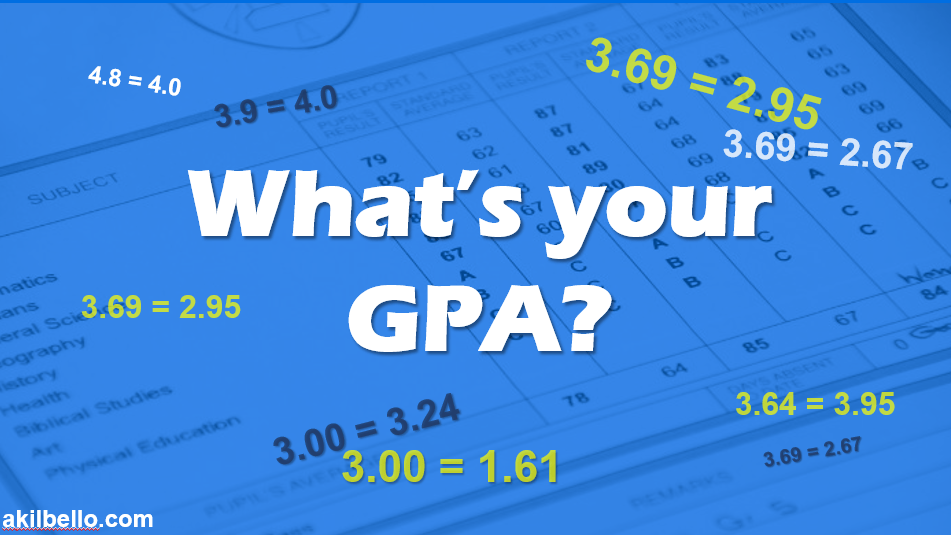
In the last few weeks, I attended and presented at both the NJ and NY Association of College Admission Counseling conferences where I spoke to lots of colleagues and friends about the admissions process. One consistent theme that emerged is that while the inputs from students are similar (classes, grades, sometimes APs and scores, sometimes essays and recommendations), the way colleges consider them is vastly different. Understanding this might be one of the biggest misunderstandings in the national conversation about admissions. We’ve all seen the stories of the student with the seemingly high GPA getting rejected from multiple schools. We’ve probably even clicked the clickbait and empathized with that student. The problem is that this narrative is just wrong.
There is no such thing as “a GPA.”
Ok, let me be more clear. There is almost no way for a student to know what GPA is being used by each college they apply to. This is one of the consequences of America not having a nationalized education system. Every institution gets to set its own curriculum, choose how it considers information, and determine what’s important. When I compared notes with a few friends who also worked as admissions readers, almost everything about how the various institutions we worked for read files was different: reading processes, how we look at files, how grades were recalculated, how essays and recommendations counted, and even how long we were expected to take with a file. The only thing in common was that we all looked carefully at the high school curriculum (not GPA . . . curriculum). So as you read this and think how un-standardized high schools and colleges are, remember that America chose diversity (state’s rights, etc) over standardization. We don’t have a standardized K-12 system and don’t have a standardized higher education system, but expect the process of transitioning between the two to be standardized.
Anyway, let me get off my soapbox and back to the nitty gritty. You don’t/can’t know your GPA!
How Do Colleges Calculate GPA?
Surprise! There is no industry standard on what is included in a GPA, how to convert from numeric to letter grades, what classes count as advanced (AP, IB, honors, etc) and should be given extra weight, or even how much weight to give advanced classes. Each high school makes its own decision about this, and each college makes its own decision.
Some colleges, when recalculating GPA, consider 9th grade through the first half of 12th grade. Some will only consider classes from 10th and 11th grades. Some will give extra weight to AP, IB, dual enrollment, honors or other “advanced” classes; others will not. So let’s play this out with a theoretical student. Here’s the transcript of a typical solid student.
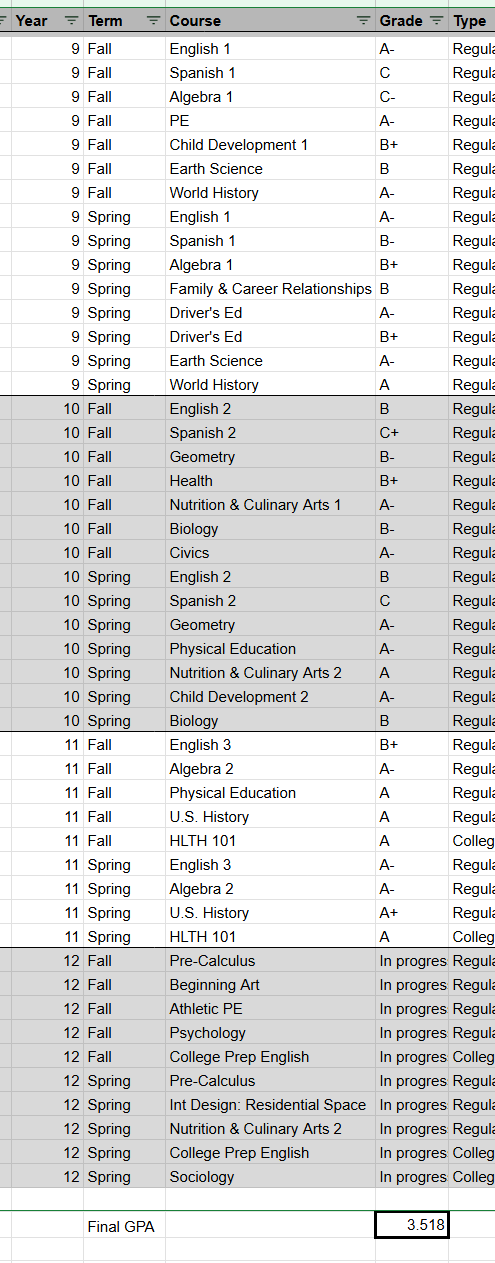
To keep things simple, this student doesn’t have a lot of AP classes or honors classes. Their high school doesn’t award extra points for dual enrollment (college) classes. Let’s take a look at how recalculations at different colleges could affect this student.
| GPA | |
| High School (all subjects, grades 9 – 11) | 3.41 |
| College 1 (core subjects, grades 10 – 11) | 3.23 |
| College 2 (core subjects, grades 9 – 11) | 3.20 |
| College 3 (all subjects, grades 9 – 11) | 3.41 |
| College 4 (all subjects, grades 10 – 11) | 3.43 |
This student thinks her GPA is 3.41, but it might be as low as 3.2 or even as high as 3.43. It’s hard to know exactly what will happen with a GPA because many colleges don’t publish how they recalculate. The University of California system is really transparent and publishes how they recalculate GPAs (which is also different for in-state and out-of-state students). The University of Georgia also publishes its recalculation factors. Some GPAs increase with recalculation, some decrease. Some increase a lot, some change not at all. Let’s look at a larger data set at a theoretical college.
| Submitted GPA | Recalculated GPA | Percent Change |
| 6.26 | 3.60 | -42.49% |
| 5.76 | 3.96 | -31.26% |
| 5.72 | 4.00 | -30.07% |
| 5.35 | 4.00 | -25.23% |
| 5.02 | 3.06 | -39.04% |
| 5.00 | 4.00 | -20.00% |
| 4.95 | 3.09 | -37.58% |
| 4.80 | 4.00 | -16.67% |
| 4.78 | 3.11 | -34.99% |
| 4.33 | 2.58 | -40.42% |
| 4.05 | 2.65 | -34.55% |
| 3.90 | 4.00 | 2.56% |
| 3.87 | 4.00 | 3.33% |
| 3.85 | 3.94 | 2.34% |
| 3.79 | 4.00 | 5.54% |
| 3.69 | 2.67 | -27.64% |
| 3.64 | 3.95 | 8.52% |
| 3.60 | 3.65 | 1.39% |
| 3.51 | 3.65 | 3.93% |
| 3.46 | 3.51 | 1.45% |
| 3.35 | 3.50 | 4.48% |
| 3.30 | 3.10 | -6.06% |
| 3.30 | 3.25 | -1.52% |
| 3.00 | 1.61 | -46.33% |
| 3.00 | 3.24 | 8.00% |
Like I said, you probably don’t know what your GPA is. For students and parents, it’s probably not worth the time to try to figure out how each college recalculates.
What’s the upshot?
The only way to be sure of how the college views your GPA is to take all the hardest classes in the country and get all As (which obviously no one can do). Otherwise, you can try to learn how every college you’re applying to recalculates GPA and evaluates rigor (not impossible but really difficult). Neither of these is likely a productive use of time.
My advice in this and in all things admissions is that students should focus on controlling what they can control, doing the best they can in school, taking courses that interest and challenge them, and participating in activities that interest them and help them grow in understanding themselves and possible careers. If a student chooses to focus on the most selective/rejective colleges, then they have to accept that there is not one magical thing that will guarantee admission. And they have to choose whether to treat admission like Giovanni in Pokemon and try to gather all the Infinity Stones. Or choose to first be a student and person (rather than a professional applicant) and do what makes them better/happier and accept that this will be enough at some colleges and not at others. At the end of the day, most students will have lots of college options because (if you’re reading this blog you know this by now) there are a lot of good schools and most of them admit far more students than they deny.
It’s probably best not to buy into the Tiktok, blogosphere, or newsmedia tendency to hyper-focus on numbers. Stay sane out there.
Let me know your thoughts, questions, and comments below.
Make sure you subscribe to get all future posts and any private posts.

 Bellowings
The fact that we need a blog post to explain GPA and can’t give an answer tells me everything you need to know about why we need standardized test scores.
LikeLike
Looks a lot like what I said about GPA a few years back! A very confusing topic and the source of much frustration. I live in CA so this is an especially fraught topic, because as you note, they only count CORE courses (math, English, science, foreign language, history and the UCs also count visual/performing arts) from 10th and 11th grades. So you could bomb 9th grade (but pass everything) and get solid grades in 10th and 11th and your GPA for out-of-state and private colleges (that count 9th grade in the GPA) would be considerably lower than for the UCs.
Also important to note that many colleges consider the upward trend of both grades and rigor, so those who aren’t perfect from the beginning have a chance to show improvement!
LikeLike