
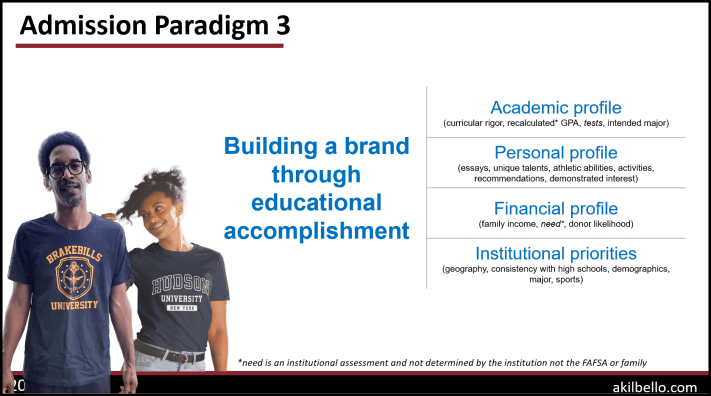
I recently wrote an article published in Word In Black about the different ways colleges go about the business of evaluating applications and even though it was long as hell, I couldn’t get in everything I wanted. So let me highlight a few bits that got left out. This is, obviously, part of my periodic series on this blog called Cutting Room Floor (the first one is here).
This article was actually inspired by conversations with my wife about the college admissions process. She sends me lots of great articles and has a great different take on some things than I do. It’s really interesting discussing things with her. This article (and this blob) is the is not the first that emerged from conversations in our living room but it is the first where I’ve publicly acknowledged it. So the paradigms that came out of our conversations are described in the article.
To write the article, I reached out to some friends like Sean Whitten who gave me some great feedback.
I reached out to some great friends and colleagues in and around who gave me great advice, suggestions, insight and feedback. Shout to Sean and Mark. My admissions homies also gave me great insight and answers. I couldn’t include everything they said in the article or said to me but in addition to what was put in the article here are a few other bits that I think I need to share:
Adrienne Oddi, Vice President for Strategic Enrollment at Queens University of Charlotte, said to me:
“When I’m looking at a student’s academic preparation, I’m thinking, simultaneously, about what the student has taken in high school and about the courses we offer at Queens. I’ve worked for 5 different universities, and we recalculated GPAs in 5 different ways. A lot of the calculations are driven by the coursework a university provides. In all cases, we were looking for students whose coursework and grades give us great confidence that the student will succeed in our classrooms. At some universities, this means looking for students who have access the toughest courses offered in their communities and ace those courses. At most universities, including Queens, being academically qualified is something much broader. We include more courses in our GPA calculations. We have more freedom in our academic requirements because we have more options for the academic on-ramp students take into our community. Students don’t have to take the toughest courses in high school in order to demonstrate readiness for Queens. We’re purposeful about helping students connect dots between disciplines, something that many students haven’t been asked to do before showing up in our classrooms. We celebrate students who have grown throughout high school, meaning they may have started with Bs and Cs and ended with Bs in courses that have prepared them well for Queens. Because we’ve got great professors here who are driven by helping students elevate their game in and out of the classroom, we’re positioned and resourced to meet students where they are and to nurture and support their rise.”
There is so much great information there, but I’ll just highlight one thing: at 5 different universities GPAs are recalculated (meaning the GPA the student submits is not the GPA the school uses to determine admissibility) in 5 different ways.
Adrienne also helped shift the article by asking:
“Will you include information about how academically qualified can stretch across different universities with different missions and different resources? I think readers may see “academically qualified” and read “high GPA.”
Finally, she damn near brought me to tears with this:
“Ultimately, for so many of us in admissions at schools that have more inclusive admissions practices versus exclusive (or rejective) admissions practices, we start reading applications from the position of “yes!” to the student. I love that I get to read applications with a “yes” mentality that is largely affirmed throughout my reading. I’ve read literally tens of thousands of applications this way, and I so wish students and families knew how empathetic the readers are at schools like mine. We’re with the students in the disappointments and challenges they share with us. And, we’re sending high fives and congratulations when we see students really shining.”
I stan Adrienne (as the kids say)!
Jay Jacobs, Vice Provost (which is college speak for fancy) at University of Vermont, replied too late for me to put this insightful tidbit into the article but it’s worth your time.
“I think your paradigms are on point. And as you know, the number of institutions in each paradigm, starting at 1 are a large volume and decreasing as you move down. The amount of press each paradigm gets is opposite, with all the press for paradigm 4 (and maybe 3) and fewer for 2 and 1. I guess what I’m trying to say is that the most of us (institutions and students) are in paradigms 1 or 2.”
This is really important for families to remember: national news outlets like to focus on national brands. So the sports-lite, less rich, less rejective colleges that give great educations tend not to get as much attention.
Here’s a reminder
| Admission rate | Number of colleges | Percent of colleges | Examples |
| 75% – 99% | 917 | 55.1% | Southern University at New Orleans, University of Illinois Chicago, Ithaca College |
| 51% – 74% | 482 | 28.9% | Auburn University, University at Buffalo (SUNY), Purdue University |
| 26% – 50% | 168 | 10.1% | SUNY Stony Brook, Dickinson College, Emerson College |
| 25% or less | 98 | 5.9% | College of the Ozarks, Babson College, Hamilton College |
What Colleges Think Is Important
I cut from the article these two images showing the criteria that IPEDS and CDS as colleges to rank.
This picture of section C7 of a Common Data Set response from a colleges, shows how it ranks the relative importance of various admissions factors.

This is IPEDS (its the navigator portal to the IPEDS data), check out the admissions considerations.

Sentences I cut, that I wish I could have worked in (and might use later)
- The perception of the impossibility of getting in has been caused by a growing echo chamber between reporters, rankers, and the other businesses that profit from the families seeking an edge in admissions and the families who rely on them. These groups generate and promote a never ending stream of claims that success in life passes exclusively through the halls of a small set of institutions, those colleges that reject the most applicants. This false impression is further muddled by magazine rankings that give the impression of objectivity and science but are truly subjective assessments of colleges’ quality, most rankings of “best” colleges are like rankings of “prettiest”.
- But admission rate does indicate popularity and in many cases institution size. Applications have spiked at many colleges in the past generation while size of the first year class hasn’t, especially at the most selective places, leading to plummeting admit rates. It is popularity and size, the greater the popularity the higher the selectivity and the smaller the college the more likely the space restriction will drive selectivity. There are good Freakonomics podcast on this. [As an aside, if you like pods I have a list of education pods I liked.]
- The businesses that sell tests, consulting, admission advice, swag, news, extra curricular experiences, and essay guidance to purportedly help someone get into college add to that complexity and misinformation by making it more difficult to find the line between marketing and reality. Not acknowledging that vast array of colleges in discussing admissions is like talking about grocery shopping and only ever mentioning Erewhon, Whole Foods, Harris Teeter, or Acme Markets.
ChatGPT
I asked chatGPT to evaluate some college data and draw conclusions, this is what it spit out (take it with a grain of salt because . . . chatGPT):
Small Institutions: Tend to be more selective, especially private ones, highlighting their exclusivity.
Medium-sized Institutions: Offer a balance between selectivity and accessibility, with varied admission rates.
Large Institutions: Generally more accessible, particularly public ones, reflecting their mission to serve larger populations.
Public Institutions: Typically have higher admission rates and larger enrollments, focusing on accessibility.
Private Institutions: Often more selective, regardless of size, emphasizing specialized programs and higher student-to-faculty ratios.
TikTok is not all terrible.
Most college focused social media stuff is terrible. It’s typically reductive and perpetuates the worst myths, stereotypes, and qAdmit theories. But I found this one TickyTok account that does a pretty good job of giving admissions stats and info but also adding context reinforcing that admissions is not a simplistic formulaic process.

Yield and Draw Rate
I wanted to delve into yield and draw rate but again it was too much.
Yield is the rate at which admitted students actually enroll. Draw rate is yield rate divided by admissions and as JoeJon Boeckenstedt explains here, it gives a better sense of how popular a college is than admissions rate alone does.
I gathered the admit and yield rates of some colleges just to look at how much the yield rates varied. You can draw your own conclusions about why, I just think its interesting.
| Admit Rate | Yield Rate (M, F) | Note, maybe explanation | |
| Wellesley College | 14 | 50 (-, 50) | Women’s college |
| Spelman College | 34 | 20 (-, 20) | Women’s college |
| Wesleyan University | 14 | 35 | Close in proximity to Wellesley |
| College of the Ozarks | 21 | 76 | Free (I think) |
| University of Miami | 19 | 25 | |
| University of California-San Diego | 25 | 22 (23, 21) | |
| Babson College | 20 | 40 (43, 36) | |
| Berea College | 25 | 65 | Free (I think) |
| University of Wisconsin-Madison | 49 | 29 | Of the schools with admit rates around 50 this has highest yield |
| Syracuse | 52 | 19 | |
| Bentley University | 48 | 22 (23, 21) | Has a lot of competition in MA |
| Baruch College | 50 | 21 (25, 17) | Big difference between male and female rate |
| California State Polytechnic University-Pomona | 55 | 13 | Of the schools with admit rates around 50 this has lowest yield |
| Brigham Young University | 67 | 76 | Mormon |

 Bellowings